Albert Lake Project

Albert Lake Project

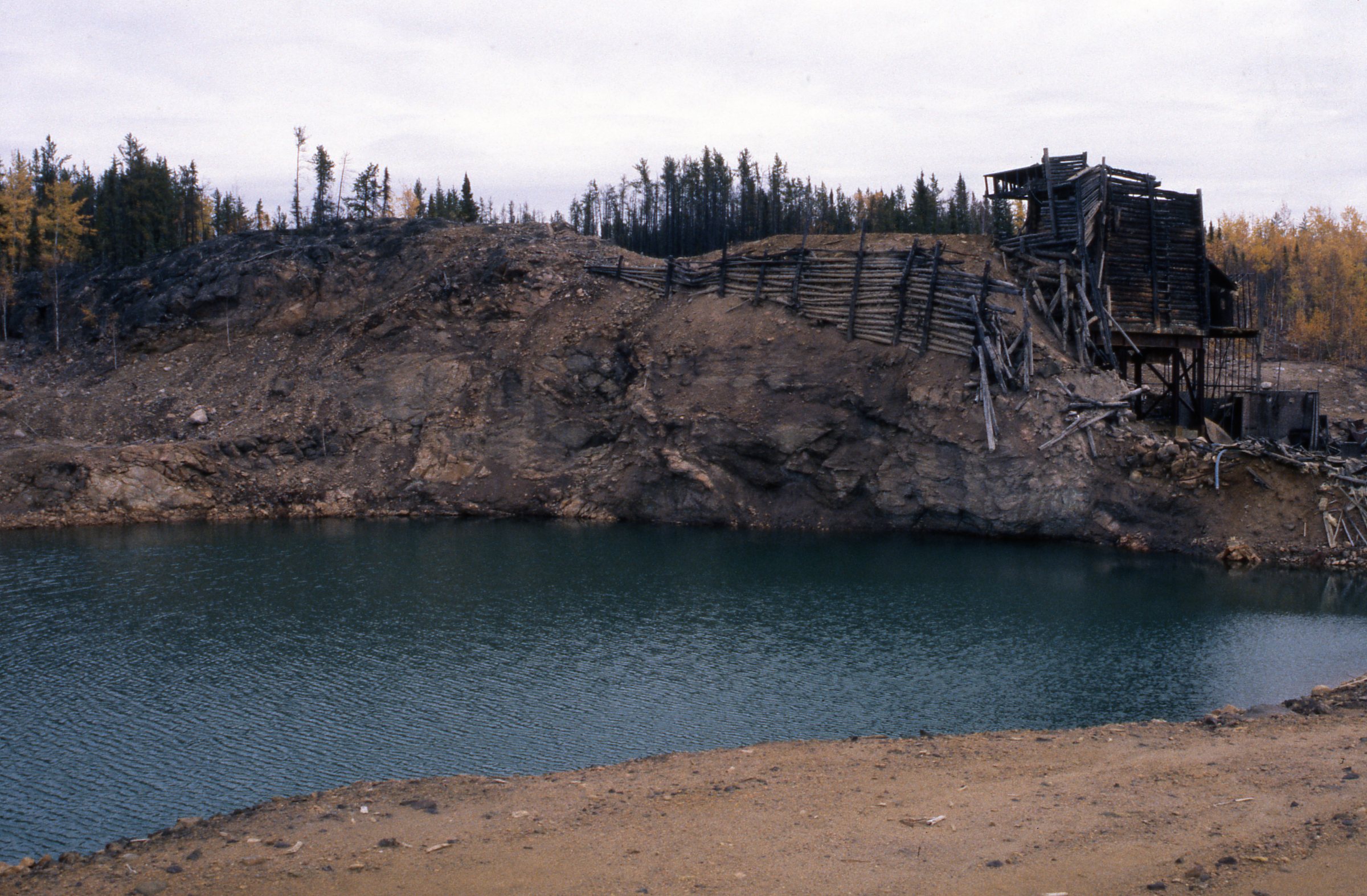
The 90,460-hectare Albert Lake property is located 135 kilometers north-northeast of La Ronge, Saskatchewan, Canada. Fathom owns 100% of the property. As a private company, Fathom conducted intermittent exploration at the project from 2016 to 2018 and, as a public company, advanced exploration more aggressively from 2021 to 2024. The property hosts the historic Rottenstone Mine [1], a small operation that produced very high-grade nickel-copper-platinum-palladium-gold mineralization between 1965 and 1969.

[1] – The Rottenstone Mine; a small open-pit mining / milling operation was in production 1965-1969. Mining in 1965 produced 5,500 short tons with a reported average production grade of 3.23% Ni, 1.83% Cu, 0.14 oz/ton Pt, 0.10 oz/ton Pd, 0.03 oz/ton Au (9.26 g/t*3E, 3E = Pd-Pt+Au) and 0.20 oz/ton Ag. Initial milling of Rottenstone mine concentrate; September 5 – November 7, 1965, produced 1,070 dry short tons of concentrate that averaged 10.83% Ni, 5.74% Cu, 0.33 oz/ton Pt, 0.53 oz/ton Pd, 0.10 oz/ ton Au (32.91 g/t* 3E) and 1.25 oz/ton Ag.  Richards, B.R. and Robinson, B.G.W. (1966), Mining and milling a small ore deposit …. Rottenstone Mining Limited: The Canadian Mining and Metallurgical Bulleting for December 1966.  The Saskatchewan Mineral Deposit Index (SMDI) #0958 reports final mine production in 1969 of 28,724 tons with an average grade of 3.28% Ni, 1.83% Cu and 9.63 g/t 3E and that approximately 9,000 tons of concentrate were sold to the International Nickel Company of Canada Limited. * A factor of 34.286 g/tonne was used to convert 1 oz/ton to g/tonne (g/t).
Geology

The Albert Lake property lies within the Rottenstone Domain of the Proterozoic Trans-Hudson orogenic belt. The Rottenstone Domain is described as a broad belt of early to late syntectonic, northeast trending arcuate tonalite to granite intrusive rocks with associated injection migmatites. The Albert Lake property is underlain by a northeast striking, northwest dipping meta-tonalite-trondhjemite-pelitic migmatite complex of Paleoproterozoic age. The area has been subjected to numerous episodes of deformation, and the metamorphic grade across the property is mid to upper amphibolite. Albert Lake stratigraphy is divided into 2-phase granitoids and supracrustal rocks. Nickel-copper-PGE mineralization occurs within and associated with ultramafic intrusions that range in composition from pyroxenite to harzburgite. Ultramafic intrusions that host the Rottenstone deposit, the Tremblay-Olson showing, the newly discovered Bay-Island Trend, and several other showings on the Albert Lake property, occur within the metasedimentary supracrustal rocks. The property is host to the famous, historic, past producing Rottenstone Mine that produced 28, 724 tons grading 3.28% Ni, 1.83% Cu, 9.63 g/t 3E1. Mineralization at the Rottenstone deposit is hosted within a harzburgite-orthopyroxenite sill. Rottenstone mineralization occurs in the form of dense, net-textured sulphides, consisting of up to 50% pyrrhotite, with lesser chalcopyrite and rarely visible pentlandite. Similar style of host rock and similar style of mineralization was discovered at the Bay-Island Trend 500m west-northwest of the Rottenstone deposit. Other mineralized ultramafic occurrences are documented occurring south of the Rottenstone deposit in the Nic5 – Tremblay-Olson (SMDI#0959) area approximately 2km south of the Rottenstone deposit.

Exploration History

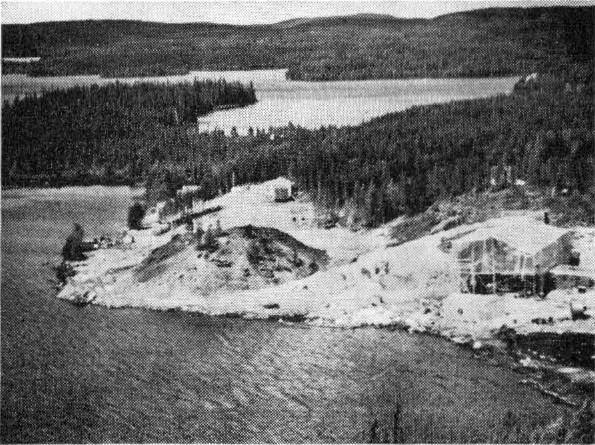
The “hill of rotten stone” (Rottenstone); a local indigenous Cree term to describe the very gossanous outcrop, first drilled in 1929. The approximate 50m diameter by 10m high outcrop was mined during the period 1965-1969. Mining and milling on site took place during the summer months and the concentrate was collected in the wintertime by trucks that transported the concentrate to the nearest highway (Hwy 102) using winter trail and ice roads. Ultimately the concentrate was shipped to INCO’s facility in Copper Cliff ON for final refinement. Exploration again occurred at Rottenstone intermittently 1987 – 2007. The very-high Ni-Cu+3E Rottenstone grade deemed to be in a small volume of rock estimated to be approximately 50,000 tons does not make geologic sense. The contained metal and exceptional metal tenors (Ni-tenor of 10-12%) has led exploration efforts in the belief that the Rottenstone deposit was derived from a very robust magmatic nickel system and Rottenstone was a hint of this robust magmatic system. Fathom Nickel Inc. is the very first company to prove this concept is correct. The Fathom 2021 discovery of the Bay-Island Trend; 300+m of Rottenstone-like mineralization, is proof of concept that the Rottenstone deposit is not an isolated occurrence but indeed part of a dynamic and open magmatic nickel sulphide system. The pathway for additional discoveries has been opened.
Photograph: Circa 1964; Mill under construction (far right) historic Rottenstone outcrop “the hill of rotten stone”, pre-mining in the foreground
Fathom Exploration 2016 – 2024

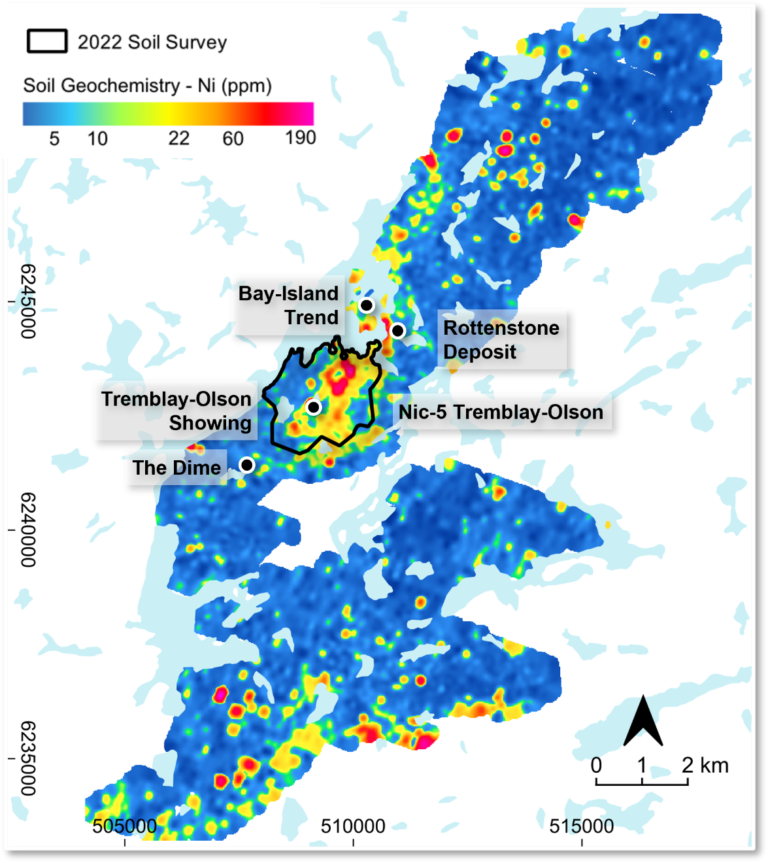
Fathom’s exploration at the Albert Lake project has been focused on demonstrating the small, very high-grade Rottenstone deposit is not a standalone, isolated deposit but a function of a large, open and dynamic magmatic nickel sulphide system. The “proof of concept”. Fathom is the first exploration company in the history of the project, dating back to 1929, to prove the Rottenstone deposit is part of a much larger dynamic system. New, separate discoveries of Rottenstone-like host rock and mineralization have been made 500 meters west-northwest of the Rottenstone mine (The Bay-Island Trend), 4.5 kilometers to the southwest of the Rottenstone mine (The Dime), and 1.5 kilometers southwest of the Rottenstone mine (Nic5 – Tremblay-Olsen). Ni-Cu+PGE-Au (platinum group elements + gold) magmatic sulphide mineralization is present at the three new discovery areas, all remain open for expansion, and in need of additional exploration programs.
2016 Exploration:
  • Diamond drilling, 11 drillholes, 467 meters
2017 Exploration:
  • Preliminary metallurgical study of Rottenstone deposit mineralization
2018 Exploration:
  • Soil geochemistry (1,478 B-horizon samples), prospecting (13 grab), geological mapping
  • Modeling of prominent 2008 VTEM™ conductors, drill target generation
  • Diamond drilling, 5 drillholes, 992 meters
  • BHEM surveys, new and historical drillholes
2021 Exploration:
  • Diamond drilling, 22 drillholes, 4,338 meters
  • Soil geochemistry (3,730 B-horizon samples), prospecting (57 grab), geological mapping
  • BHEM surveys, new and historic drillholes, 11.8 ln-km TDEM, and gravity survey (774 stations)
  • Airborne Gradient MAG survey, 9,595 ln-km
2022 Exploration:
  • Diamond drilling, 34 drillholes, 5,589 meters
  • Completed pXRF lithogeochemistry of historic drillholes (63 drillholes)
  • BHEM surveys, 43.3 ln-km TDEM
  • Soil geochemistry (1,003 B-horizon samples), prospecting (29 grab), geological mapping
  • Airborne AirTEM survey, 2,715 ln-km
2023 Exploration:
  • Diamond drilling, 2 drillholes, 701 meters
  • BHEM surveys, 38.0 ln-km TDEM, and gravity survey (507 stations)
2024 Exploration:
  • Diamond drilling, 6 drillholes, 1,386 meters
  • BHEM surveys, 9.3 ln-km TDEM, and gravity survey (167 stations)
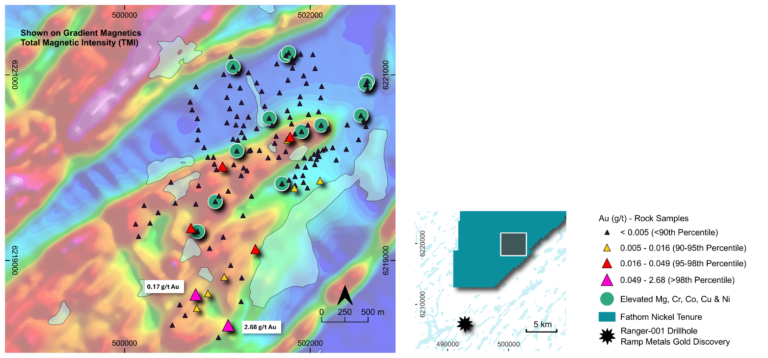
  • Prospecting southern end of the property for Au, Ni-Cu+PGE potential.
  • 144 outcrop grab samples; 1 sample returned 2.68 g/t Au.
  • Mafic-ultramafic rocks encountered in area prospected.
Project Exploration History
  • The Rottenstone deposit high-grade nickel-copper + Pt-Pd was first recognized and drilled in 1929
  • With the advent of HWY 102 north of La Ronge circa 1948 came renewed interest in the Rottenstone deposit and surrounding area.
  • Mining of the Rottenstone deposit commenced 1965 and final shipment of Rottenstone mine concentrate was in the winter months of 1969.
  • In 1985 the historic Rottenstone mineral lease was made available and intermittent surface exploration (mapping, prospecting geophysics) was performed in the Rottenstone mine area through 1990.
  • Active exploration centred on the Rottenstone mine area and surrounds occurred 1998-2003 consisting of airborne biogeochemical survey, airborne geophysics, surface geophysics, soil geochemistry and diamond drilling (40 drillholes, 8,143 meters).
  • In 2008 a VTEM™ survey centred over the Rottenstone deposit area was flown (1,144 ln-km) and 7 drillholes (1,176 meters) tested several conductors outlined by VTEM™ survey.
Project Deposit Area Geology
  • The Albert Lake project falls within the Rottenstone Domain of the Proterozoic (1.8 – 2.0 Ga) Trans Hudson Orogenic (THO) belt.
  • The THO in neighbouring Manitoba and northern Quebec host Proterozoic, World Class nickel camps (Thompson, Lynn Lake, Raglan, Nunavik).
  • The property area is underlain by a broad belt of early to late syntectonic, northeast trending arcuate tonalite to granite intrusive rocks with associated injection migmatites.
  • The historic Rottenstone deposit is hosted within an ultramafic sill-like body occurring within metasedimentary supracrustal rocks.
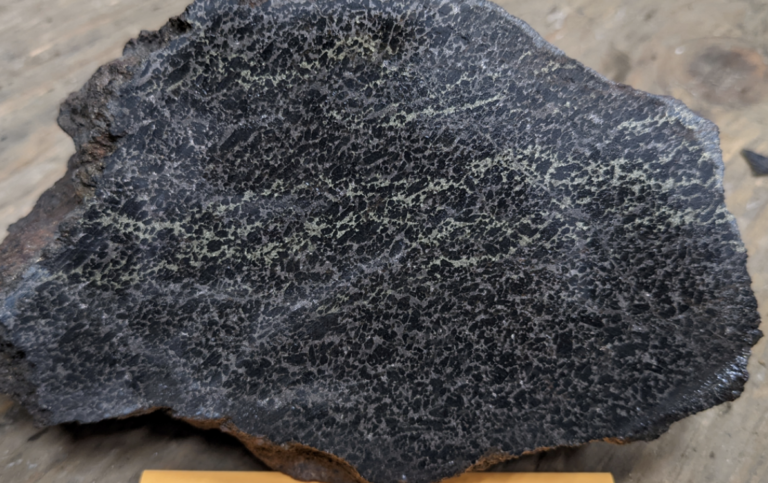
  • Net-texture sulphides (pyrrhotite-pentlandite-chalcopyrite) dominate the Rottenstone mineralization. Massive sulphide has been observed in rock samples surrounding the historic Rottenstone mine workings.
  • Very high PGE grades along with high metal tenors define the Rottenstone-style mineralization.

Typical Rottenstone mine / deposit net-texture sulphide mineralization
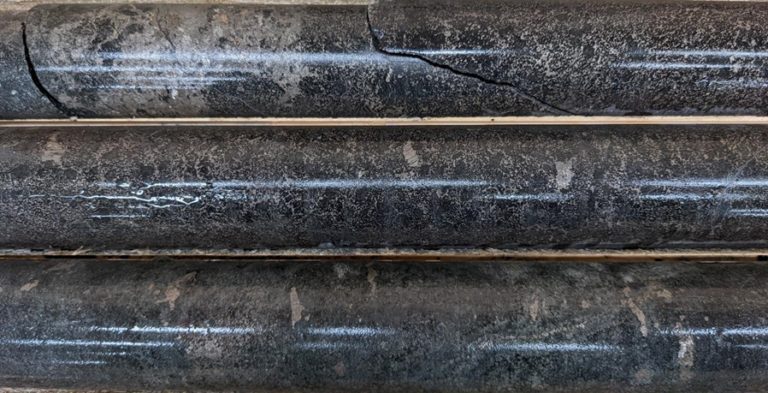
Rottenstone-like disseminated-blebby and net-texture sulphide mineralization, Bay-Island Trend 500m west-northwest of the Rottenstone deposit
South Albert Lake project 2024 prospecting sample location map