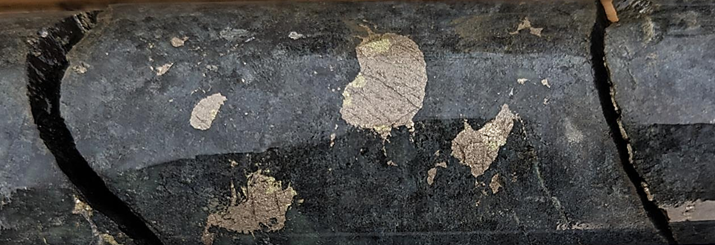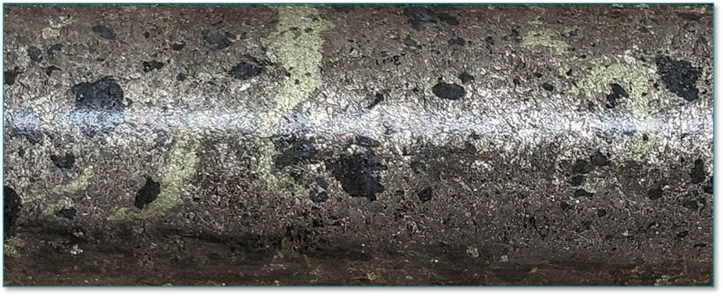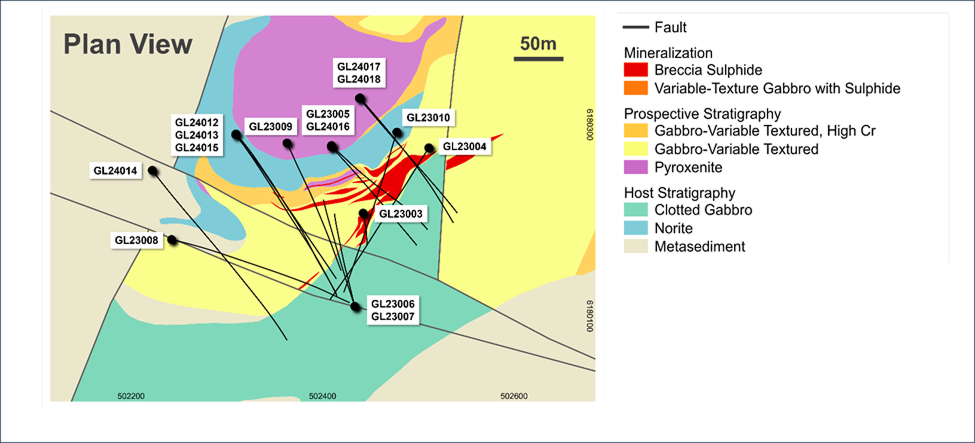
The Gochager Lake property falls within the interpreted border of the Rottenstone and La Ronge Domain of the Proterozoic (1.8 – 2.0 Ga) Trans-Hudson orogenic belt (the THO or Trans Hudson Corridor). The Gochager Lake property area is underlain by a monotonous succession of northeast-trending, heavily foliated biotite gneiss or biotite migmatite. The southern and eastern part of the property show highly foliated lenticular bands of hornblendite and hornblende gneiss, while the centre of the property hosts small, scattered intrusive dioritic and gabbroic bodies that vary in size from 300 m to 1.8 km in length and are aligned with the regional northeasterly trend. The historic Gochager Lake deposit is hosted within a chaotic, complex, intrusive suite composed of norite and variable textured gabbro and ultramafic rocks (pyroxenite). Pyrrhotite is the dominant sulphide mineral within the deposit, and occurs as stringers, blebs, disseminations, and net-texture, as well as in a semi-massive to massive sulphide breccia form. Pentlandite occurs as coarse disseminations within the pyrrhotite, and chalcopyrite is additionally present as stringers and interstitial blebs in low concentrations throughout the deposit. Cobalt, a significant component to the Gochager style of mineralization, is directly associated with pentlandite.